Understanding how climate change transforms political risks for businesses
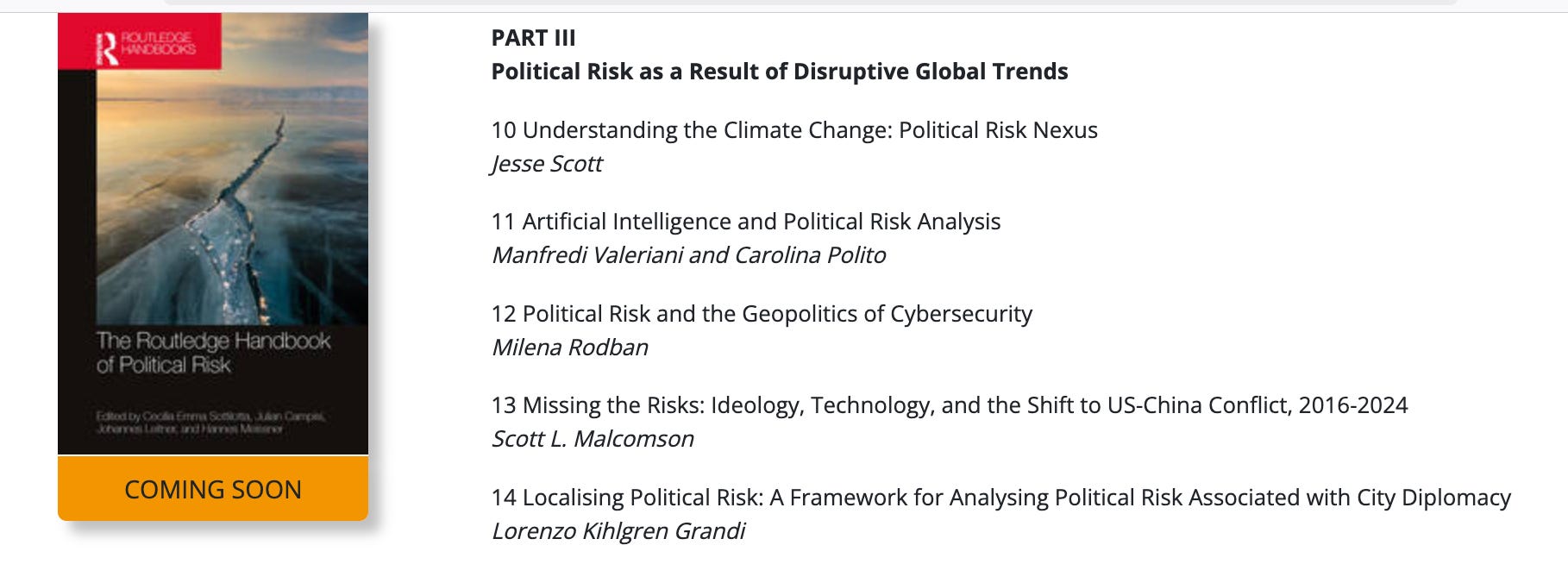
Forthcoming with the new Routledge Handbook of Political Risk (March 2025)

Climate change poses many challenges for the theory and practice of political risk assessment. This is as yet a largely uncharted landscape, partly because risk means different things to investors and to scientists.
My chapter in the forthcoming Routledge Handbook of Political Risk lays out how the destabilizing impact of the changing climate is now inseparable from domestic and international politics, more closely linking political risk to physical risk, policy uncertainty, financial risk, transition risk, and systemic risks.
Today’s accelerating changes in earth system physics are a clear causal or multiplying factor for other crises, including social stress, violent crime, and political instability. Equally clearly, there is no country in which diverse political and business stakeholders are not experiencing — and exploiting — disagreement about possible responses to climate change.
My chapter looks in particular at the energy sector transition and the insurance sector. It also argues that climate change means that business strategies increasingly pose risks for governments. Finally, I argue that political risk thinking can also potentially inform the field of climate risk analyses, which sometimes underestimate political dynamics, including mistaking how businesses assess these dynamics as part of their investment decisions.
Chapter sections include:
➡️ Climate change significantly changes political risk and its assessment
➡️ Defining climate risks
➡️ Including climate change in political risk analyses
➡️ Energy transition and political risk
➡️ Turning the tables: business as a risk factor in climate policy
➡️ Big changes at the tail: climate disasters and “loss and damage”
➡️ Adding political risk into the climate action toolkit
With big thanks to editors Cecilia Emma Sottilotta, Julian Campisi, Johannes Sebastian Leitner, and Dr. Hannes Meissner.